Greek Isopsephy Value Chart
The full Milesian numeral system: 27 values across three ranks of nine, including the three archaic letters that survived as numbers after they stopped being sounds.
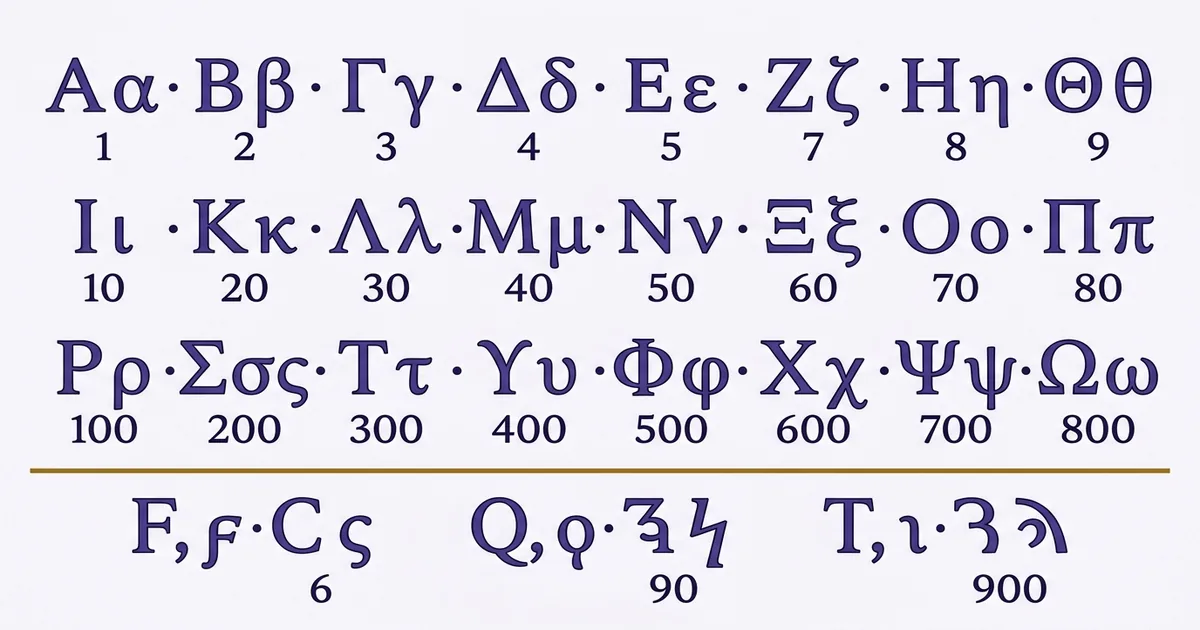
The Full Table
| Letter | Name | Isopsephy | Reduced |
|---|---|---|---|
| α | Alpha | 1 | 1 |
| β | Beta | 2 | 2 |
| γ | Gamma | 3 | 3 |
| δ | Delta | 4 | 4 |
| ε | Epsilon | 5 | 5 |
| ϝ | Digamma | 6 | 6 |
| ζ | Zeta | 7 | 7 |
| η | Eta | 8 | 8 |
| θ | Theta | 9 | 9 |
| ι | Iota | 10 | 1 |
| κ | Kappa | 20 | 2 |
| λ | Lambda | 30 | 3 |
| μ | Mu | 40 | 4 |
| ν | Nu | 50 | 5 |
| ξ | Xi | 60 | 6 |
| ο | Omicron | 70 | 7 |
| π | Pi | 80 | 8 |
| ϙ | Qoppa | 90 | 9 |
| ρ | Rho | 100 | 1 |
| σ / ς | Sigma | 200 | 2 |
| τ | Tau | 300 | 3 |
| υ | Upsilon | 400 | 4 |
| φ | Phi | 500 | 5 |
| χ | Chi | 600 | 6 |
| ψ | Psi | 700 | 7 |
| ω | Omega | 800 | 8 |
| ϡ | Sampi | 900 | 9 |
The Three Archaic Numerals
Digamma sits at 6, qoppa at 90 and sampi at 900. None of the three is part of the 24 letter classical alphabet you would learn for reading Greek, because all three had dropped out of speech by the classical period. They stayed in the numeral system for the simple reason that arithmetic needed 27 symbols and the alphabet only offered 24. In manuscripts digamma is often written as the stigma ligature, which is why the same value sometimes appears under a different name.
Accents, Breathings and Final Sigma
Polytonic Greek carries a lot of marks, and none of them is worth anything numerically. Acute, grave and circumflex accents, rough and smooth breathings, the iota subscript and the diaeresis are all stripped before counting. Final sigma and medial sigma are one letter in two shapes and are both worth 200, unlike the Hebrew finals, which genuinely diverge under Mispar Gadol.
Numbers Worth Recognising
888 - Ἰησοῦς
Iesous. 10+8+200+70+400+200, and cited by early Christian writers as a deliberate counterweight to 666.
666
The number of Revelation 13:18, most convincingly reconstructed as the Hebrew spelling of Nero Caesar rather than a Greek word.
373 - λόγος
Logos, the word that opens the Gospel of John.
801 - αω
Alpha and omega, 1 plus 800, the first and last letters read as a single number.
How Greek Actually Wrote Its Numbers
The values in this table are not a gematria convention laid over the alphabet. They are how Greek wrote numbers for well over a thousand years, and knowing the notation makes ancient texts considerably easier to read.
A letter used as a numeral was marked with a keraia, a small stroke after it, so that iota followed by alpha and a keraia reads as eleven rather than as a syllable. Numerals were written in descending order of value, so 247 appears as sigma, mu, zeta: 200 plus 40 plus 7.
Thousands were handled with a mark below and to the left of the letter, restarting the ladder, so alpha carrying that mark is 1,000 rather than 1. This gave Greek a compact way of writing any number up to 999,999 using the same 27 symbols, which is part of why the system survived so long despite having no zero.
What You Will Meet in Manuscripts
Printed tables are tidier than the sources. Three variations account for most of the confusion when you move from a chart like this one to an actual text.
Stigma for Digamma
The 6 position is frequently written as the stigma ligature rather than digamma. Same value, different shape, and often a different name in older tables.
Lunate Sigma
Sigma commonly appears as a crescent with no separate final form. It is still 200 in every position.
Uppercase Throughout
Early manuscripts are written entirely in capitals with no spaces between words. Case never affects the value.
None of these changes the arithmetic. They change how quickly you recognise which letter you are looking at, which is the actual skill when reading a number off a page rather than off a table.
Why the Ladder Matches Hebrew so Closely
Set this table beside the Hebrew chart and the correspondence is hard to miss: alpha with alef at 1, iota with yod at 10, rho with qof at 100. That is inheritance rather than coincidence. The Greek alphabet was adapted from Phoenician, the same source the Hebrew alphabet takes its order from, and the numeral values follow the inherited sequence.
The two systems diverge only where the alphabets do. Greek kept three obsolete letters to complete the ladder to 900. Hebrew, which ends at 400, later pressed its five final forms into the same gap under Mispar Gadol. Two different patches on one structural problem: an alphabet of roughly twenty two letters cannot fill twenty seven numeral slots.
Calculate a Word
Paste Greek text, accented or bare, into the Greek isopsephy calculator for the total, the ordinal position and the reduced digit, with the arithmetic shown letter by letter.