English Gematria Calculator
Type any English word, name or phrase and get all seven ciphers side by side. Each card opens to show which letter contributed what, so you can check the total by hand.
The Seven English Ciphers
English gematria is younger than the Hebrew practice and far less standardised. What exists instead is a handful of ciphers, each internally consistent, each producing a different number for the same word. Running all of them at once is the only honest way to work, because it makes the spread visible instead of hiding it.
English Ordinal
A=1 through Z=26. The baseline, and the one most sources mean when they give a bare number.
English Reverse
The alphabet read backwards, A=26 down to Z=1.
Pythagorean
Full reduction to 1-9. The cipher behind modern name numerology.
Reverse Full Reduction
The reverse alphabet, then reduced to a single digit.
Sumerian
Ordinal multiplied by six, giving A=6 and Z=156.
Reverse Sumerian
The reverse alphabet multiplied by six.
Jewish Gematria
Latin letters on the Hebrew ladder of units, tens and hundreds.
A Worked Example
Take LOVE. In English Ordinal: L=12, O=15, V=22, E=5, giving 54, which reduces to 9. In Pythagorean the same letters become 3+6+4+5 = 18, which also reduces to 9. That agreement is not mystical, it is arithmetic: reducing a number and reducing the parts that built it land in the same place.
The spread appears elsewhere. WISDOM is 83 in Ordinal but 79 in Reverse, 498 in Sumerian and 1083 in Jewish Gematria. Four numbers, one word, no contradiction, because each belongs to a different cipher.
English Letter Values in Full
| Letter | Ordinal | Reverse | Pythagorean | Sumerian | Jewish |
|---|---|---|---|---|---|
| A | 1 | 26 | 1 | 6 | 1 |
| B | 2 | 25 | 2 | 12 | 2 |
| C | 3 | 24 | 3 | 18 | 3 |
| D | 4 | 23 | 4 | 24 | 4 |
| E | 5 | 22 | 5 | 30 | 5 |
| F | 6 | 21 | 6 | 36 | 6 |
| G | 7 | 20 | 7 | 42 | 7 |
| H | 8 | 19 | 8 | 48 | 8 |
| I | 9 | 18 | 9 | 54 | 9 |
| J | 10 | 17 | 1 | 60 | 600 |
| K | 11 | 16 | 2 | 66 | 10 |
| L | 12 | 15 | 3 | 72 | 20 |
| M | 13 | 14 | 4 | 78 | 30 |
| N | 14 | 13 | 5 | 84 | 40 |
| O | 15 | 12 | 6 | 90 | 50 |
| P | 16 | 11 | 7 | 96 | 60 |
| Q | 17 | 10 | 8 | 102 | 70 |
| R | 18 | 9 | 9 | 108 | 80 |
| S | 19 | 8 | 1 | 114 | 90 |
| T | 20 | 7 | 2 | 120 | 100 |
| U | 21 | 6 | 3 | 126 | 200 |
| V | 22 | 5 | 4 | 132 | 700 |
| W | 23 | 4 | 5 | 138 | 900 |
| X | 24 | 3 | 6 | 144 | 300 |
| Y | 25 | 2 | 7 | 150 | 400 |
| Z | 26 | 1 | 8 | 156 | 500 |
The same table in printable form is on the English gematria chart page.
Choosing a Cipher and Staying in It
The most common error in English gematria is comparing two words calculated in two different systems. If a source says a phrase equals 137, that number is meaningless until you know which cipher produced it. Before comparing anything, fix the cipher, then run every word through that one column.
The second most common error is treating a large Jewish Gematria total as if it were an Ordinal total. Because that cipher reaches 900 on a single letter, its numbers are simply on a different scale, and coincidences that look striking there are usually just the effect of a wider range.
Related Tools
Hebrew Gematria Calculator
Mispar Hechrachi, Gadol, Siduri and Katan.
Greek Isopsephy Calculator
Alpha to sampi, with accents stripped automatically.
English Gematria Chart
All 26 letters across every English cipher.
Frequently Asked Questions
Which English gematria system is the correct one?
None of them is more official than the others. English Ordinal is the most widely used and the easiest to check by hand, Pythagorean underpins modern name numerology, and Jewish Gematria is the one that borrows the Hebrew ladder. Pick the system your source is using and stay in it.
What is the Sumerian cipher?
It is English Ordinal multiplied by six, so A is 6 and Z is 156. Despite the name it has no connection to ancient Sumer; it is a modern variant that produces larger, more distinctive totals.
Why is Jewish Gematria so different from Ordinal?
Because it does not count 1 to 26. It maps the Latin alphabet onto the Hebrew structure of units, tens and hundreds, so a single letter can be worth 900. Totals in this cipher are typically an order of magnitude larger.
Does capitalisation matter?
No. Everything is converted to capitals before the letters are looked up, and spaces, digits and punctuation are ignored.
What does the reduced value mean?
It is the digital root. The digits of the total are added repeatedly until one digit is left, so 83 becomes 8+3 = 11, then 1+1 = 2.
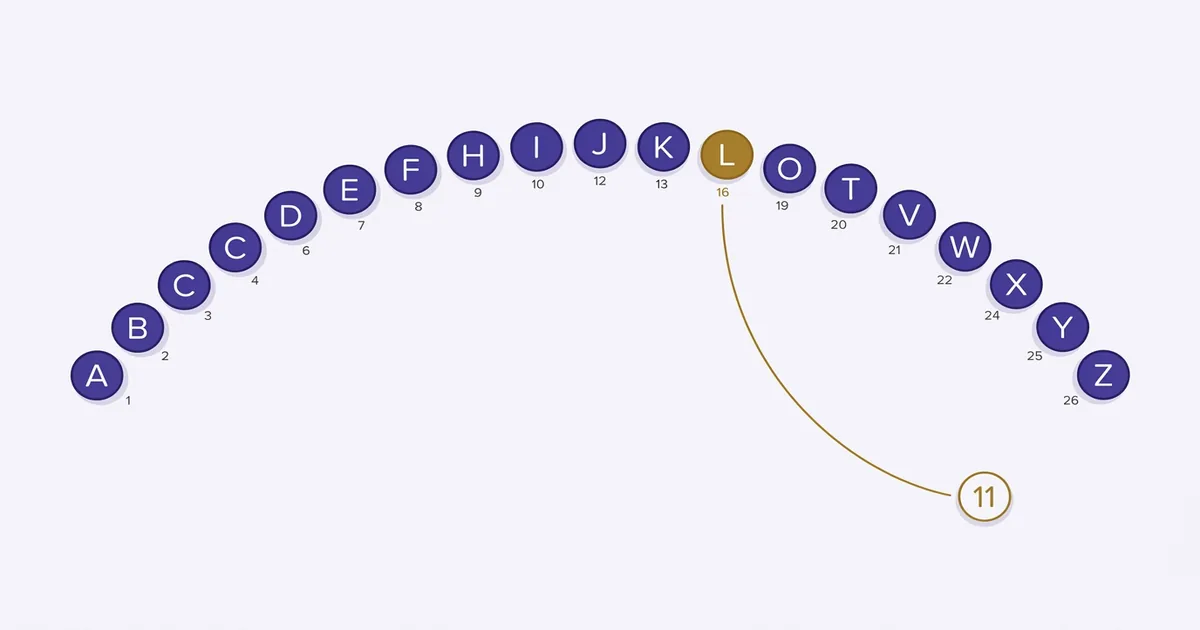
What is English Qaballa or the ALW cipher?
A different English system entirely, developed in 1976 by James Lees to interpret Aleister Crowley's The Book of the Law. Rather than running A to Z in order, it renumbers the alphabet in steps of eleven (A=1, L=2, W=3, and so on), so it isn't a variant of Ordinal, it's a different letter order. It belongs to Thelemic occult practice specifically and is outside the scope of the seven general-purpose ciphers here.
Is this the same as a plain word value calculator?
English Ordinal, the first cipher shown, is exactly that: A=1 through Z=26, summed. If all you want is the plain letter-sum some sites call a word value calculator, Ordinal is that number - this page just also runs six further ciphers alongside it rather than stopping there.
Can I calculate a name instead of a common word?
Yes, names work exactly like any other word here: the letters go in, every cipher runs, and the arithmetic is shown for each. The one thing worth knowing is that the calculation is of the spelling you type, so a nickname and a full legal name will return different numbers even for the same person.