Greek Isopsephy Calculator
Isopsephy is the Greek cousin of Hebrew gematria and works on the same ladder of units, tens and hundreds. Paste polytonic or bare Greek: accents, breathings and the iota subscript are stripped before the letters are counted.
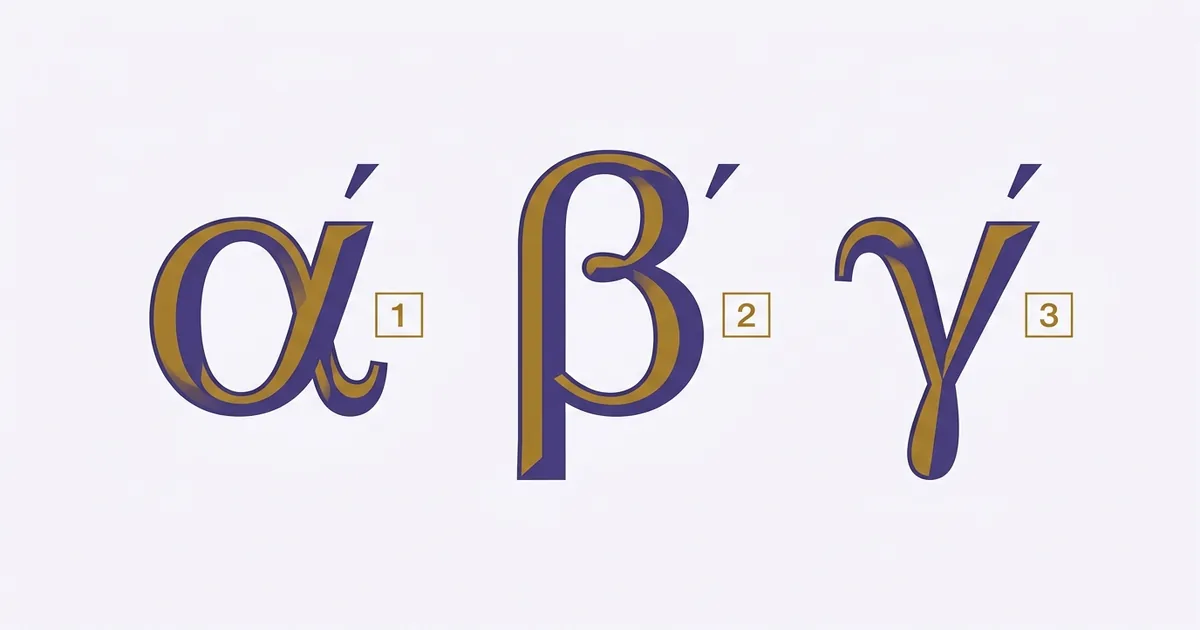
How the Greek Numerals Work
The Milesian system splits 27 numerals into three ranks of nine. Alpha to theta run 1 to 9, iota to qoppa run 10 to 90, and rho to sampi run 100 to 900. It is the same architecture as the Hebrew ladder, which is no accident: both descend from the Phoenician alphabet and its order.
Three of those numerals are letters that fell out of ordinary Greek writing. Digamma holds the 6 slot, qoppa the 90 slot and sampi the 900 slot. Without them the 24 letter classical alphabet could not fill all 27 positions, which is why they survived as numbers long after they stopped being sounds.
A Worked Example
λόγος (logos): lambda 30, omicron 70, gamma 3, omicron 70, sigma 200. The total is 373.
Ἰησοῦς (Iesous): iota 10, eta 8, sigma 200, omicron 70, upsilon 400, sigma 200. The total is 888, a number early Christian writers pointed to deliberately, and one of the most cited results in the whole history of isopsephy. Note that the accents and the circumflex change nothing.
Greek Letter Values in Full
| Letter | Name | Isopsephy | Reduced |
|---|---|---|---|
| α | Alpha | 1 | 1 |
| β | Beta | 2 | 2 |
| γ | Gamma | 3 | 3 |
| δ | Delta | 4 | 4 |
| ε | Epsilon | 5 | 5 |
| ϝ | Digamma | 6 | 6 |
| ζ | Zeta | 7 | 7 |
| η | Eta | 8 | 8 |
| θ | Theta | 9 | 9 |
| ι | Iota | 10 | 1 |
| κ | Kappa | 20 | 2 |
| λ | Lambda | 30 | 3 |
| μ | Mu | 40 | 4 |
| ν | Nu | 50 | 5 |
| ξ | Xi | 60 | 6 |
| ο | Omicron | 70 | 7 |
| π | Pi | 80 | 8 |
| ϙ | Qoppa | 90 | 9 |
| ρ | Rho | 100 | 1 |
| σ / ς | Sigma | 200 | 2 |
| τ | Tau | 300 | 3 |
| υ | Upsilon | 400 | 4 |
| φ | Phi | 500 | 5 |
| χ | Chi | 600 | 6 |
| ψ | Psi | 700 | 7 |
| ω | Omega | 800 | 8 |
| ϡ | Sampi | 900 | 9 |
The printable version is on the Greek isopsephy chart page. If you have a Greek numeral and want the number it stands for rather than a word's value, use the numerals converter.
Isopsephy in the Ancient World
Unlike much of what circulates as gematria today, Greek isopsephy is attested in ordinary use, outside scripture and centuries before anyone was decoding Revelation. One of the clearest examples survives as graffiti scratched into a wall in Pompeii, sealed under ash in 79 CE: a lover wrote that the woman he adored had a name whose isopsephic value was 545. Nearby, another inscription simply records that a lady's "honourable name is 45." Neither is scripture, neither is prophecy. It is a Roman using the same arithmetic this calculator runs, to make the same kind of point people still make with a number today.
The technique could cut the other way too. The historian Suetonius records a wall slogan from Rome, decades after Nero's death, that equated the numeral value of his name (1005) with the phrase "he killed his own mother" - a political insult built entirely out of matching sums. Isopsephy was not only devotional; it was also, on occasion, graffiti with a point to make.
Because Greek used its letters as its digits, treating a word as a number required no special theory. It was simply what the characters already were, which is why the practice shows up in Hellenistic riddles and epigrams as well as in the numeric wordplay that runs through parts of the New Testament.
That is worth keeping in mind when reading modern claims. In an alphabet where letters are digits, coincidences of total are common and were understood to be common. The ancient authors who used the technique treated it as wordplay and allusion, not as proof.
Related Tools
Hebrew Gematria Calculator
The older ladder, in four classical methods.
English Gematria Calculator
Seven modern English ciphers at once.
Greek Isopsephy Chart
All 27 numerals including digamma, qoppa and sampi.
Greek Numerals Converter
Read a Greek numeral as a number, or write a number the way Greek did.
Frequently Asked Questions
What is isopsephy?
Isopsephy is the Greek equivalent of gematria: each letter of the Milesian numeral system carries a value, and the values of a word are added together. The word means roughly equal in pebbles, from the counting stones used for arithmetic.
Do accents and breathing marks change the value?
No. Tonos, the rough and smooth breathings, the iota subscript and the diaeresis carry no numeric value. They are stripped before calculating, so polytonic text totals the same as bare text.
Why does the alphabet include letters I do not recognise?
Digamma (6), qoppa (90) and sampi (900) dropped out of ordinary writing but stayed in the numeral system, which is why the classical 24 letter alphabet has to be padded back to 27 numerals.
What is the value of 666?
The number of the beast in Revelation is usually read as an isopsephic total, and the most widely accepted reconstruction is the Hebrew spelling of Nero Caesar rather than a Greek word. It is the clearest surviving example of the technique being used deliberately in a text.
Does final sigma count differently?
No. Final sigma and medial sigma are the same letter in two shapes, and both are worth 200.
Is isopsephy only found in religious or mystical texts?
No. It also survives as ordinary graffiti - a wall in Pompeii, buried by the eruption of 79 CE, records a lover noting that his beloved's name totals 545. The technique was used for wordplay, insults and inscriptions long before anyone applied it to scripture.